
22 SEPTEMBER, 2026
The insurance chain is broken. Here's what fixing it looks like.
Joseph Thompson, Head of Speciality, ZNG Group
Every industry eventually confronts a moment where the way things have always been done stops serving the people it's meant to serve. For Jewellers Block insurance, that moment is now.
Walk through the current model and the problem becomes obvious fast. A jeweller or watch retailer wants cover for their stock. To get it, they go through a broker, who is distributing a product designed by an underwriter, who is several steps removed from the actual risk sitting on the shop floor. Layer on top of that dense, legalistic wording that few outside the industry can parse, and you have a chain that is long, opaque, and quietly working against the people paying for it.
This isn't a minor inefficiency. It's a structural problem, and it has three consequences that matter.
Walk through the current model and the problem becomes obvious fast. A jeweller or watch retailer wants cover for their stock. To get it, they go through a broker, who is distributing a product designed by an underwriter, who is several steps removed from the actual risk sitting on the shop floor. Layer on top of that dense, legalistic wording that few outside the industry can parse, and you have a chain that is long, opaque, and quietly working against the people paying for it.
This isn't a minor inefficiency. It's a structural problem, and it has three consequences that matter.
- It slows everything down.
Onboarding takes too long. Portfolio management is manual and clunky. Every extra link in the chain is an extra delay when a client needs an answer.
- It disempowers the client.
When a policyholder can't understand their own wording without a broker translating it for them, they've lost the ability to make informed decisions about their own risk. That's not protection, it's dependency.
The further the actual underwriting authority sits from the point of sale, the harder it becomes to move quickly and fairly when something goes wrong. Claims are where insurance either proves its worth or exposes its flaws, and a long chain of intermediaries rarely helps in that moment.
A DIFFERENT STARTING POINT
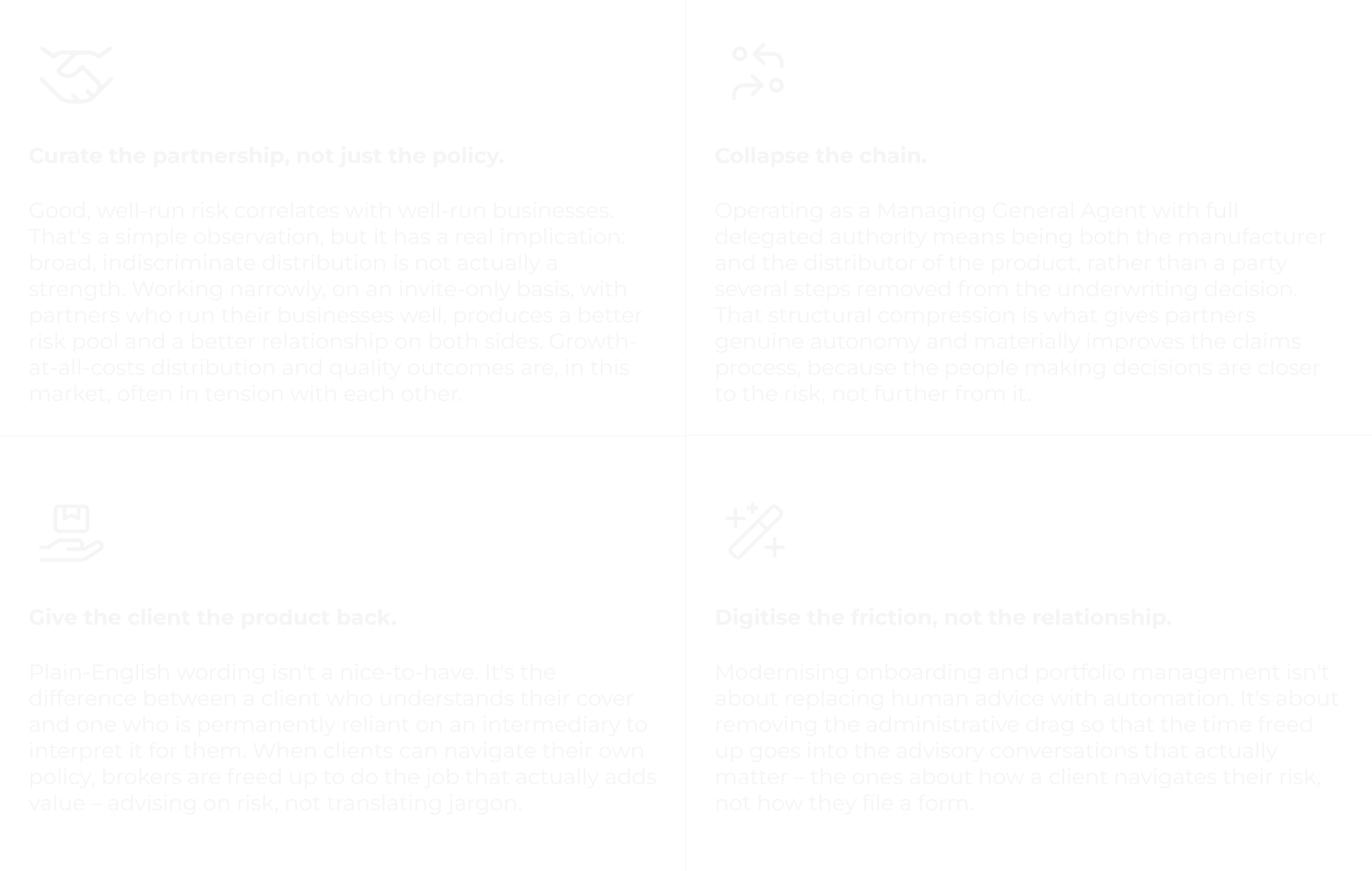
The fix isn't a better broker relationship or a slightly clearer wording template bolted onto the same structure. It requires rethinking who does what in the chain, and why.
WHAT THIS LOOKS LIKE IN PRACTICE
Modernisation isn't a slogan; it shows up in the specifics of the cover itself. A few examples of where the current market has gaps worth closing:
- Valuing the full cost of loss, not just the sticker price. When stock is lost, cover should reflect the original acquisition cost plus the costs a business incurred to bring that item to a retail-ready state - servicing, polishing, registration, marketing, and any appreciation in value since. This matters acutely in areas like the Rolex CPO programme, where the true cost of getting stock retail-ready is significant and, in our view, currently under-recognised by the market.
- Protecting the intangible, not just the physical. Loss or damage to box and papers has a real, measurable impact on a watch's value, independent of any damage to the watch itself. Cover should reflect that.
- Extending protection beyond the point of sale. Defective title exposure on pre-owned stock doesn't end the moment a sale completes. Covering that risk for years afterward - not days or months - gives both the retailer and the end client meaningfully longer peace of mind.
WHY THIS MATTERS BEYOND ONE PRODUCT LINE
The Jewellers Block market is a useful case study precisely because it's a microcosm of a much bigger pattern across specialty insurance: complexity accumulates, distances between decision-makers and risk grow, and clients end up bearing the cost of both. Modernising it isn't about being disruptive for its own sake. It's about asking a straightforward question - does this structure genuinely serve the people relying on it? - and being willing to rebuild where the answer is no.
The result, done properly, isn't just a better product. It's a market that moves faster, communicates more honestly, and produces better outcomes when it matters most - at the point of claim.
That's the standard worth building toward.
The result, done properly, isn't just a better product. It's a market that moves faster, communicates more honestly, and produces better outcomes when it matters most - at the point of claim.
That's the standard worth building toward.